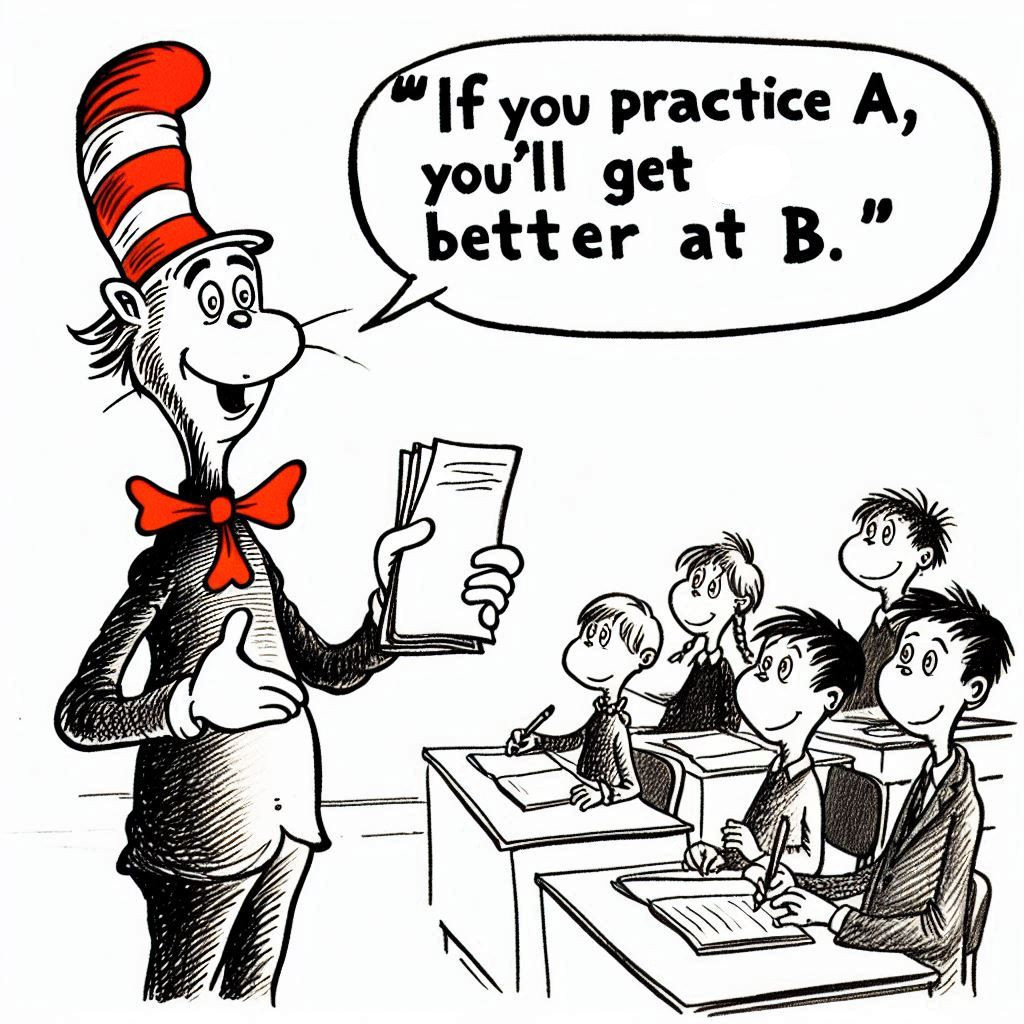
Haga clic aquí para la traducción al español (Google Translate) Introduction Effective language learning means engaging in meaningful tasks that develop the knowledge, skills, & attitudes that are necessary for real-world communication. Transfer appropriate processing (TAP) is a fundamental principle in instructional design that ensures learning activities develop the competencies students need to participate in… Continue reading Transfer appropriate processing in language learning: A fundamental principle
How multitasking inhibits learning

Haga clic aquí para la traducción al español (Google Translate) Introduction In today’s tech, social media, & smartphone dominated world, multitasking is often believed to make us more productive. However, research suggests that this modern-day “skill” may be more harmful than helpful, particularly when it comes to learning. From impaired focus to decreased memory retention,… Continue reading How multitasking inhibits learning
Meaning first: Why connecting form and meaning is essential for language learning

Haga clic aquí para la traducción al español (Google Translate) Introduction Language learning is far more than memorising vocabulary & grammar rules; it is about understanding & using language meaningfully in real-world contexts. For learners, this involves making connections between linguistic forms & their functions in communication. Whether students aim to join discourse communities, handle… Continue reading Meaning first: Why connecting form and meaning is essential for language learning
LLMs and students’ writing: Thinking it through
Haga clic aquí para la traducción al español (Google Translate) I’m just sharing my experiences and thoughts because I think it’s an important consideration for using large language models (LLMs), e.g. Google’s Gemini, OpenAI’s ChatGPT in language learning & teaching. It’s interesting to see people’s attitudes to AI generated content. I experimented with using an… Continue reading LLMs and students’ writing: Thinking it through
It’s Time to Move on from Emergency Remote Teaching

Haga clic aquí para la traducción al español (Google Translate) Since the COVID-19 lock-downs the ELT industry appears to be equating emergency remote teaching (ERT) with online & distance education. This is highly problematic. ERT was a stop-gap measure, the best that teachers could pull together in a very short time with few resources &… Continue reading It’s Time to Move on from Emergency Remote Teaching
Improving the quality of teaching
Who’d have thought it? According to a research review (Kini & Podolsky, 2016), students’ academic performance & attendance correlate with their teachers’ years of teaching experience. The effects are strongest within the first 2-3 years of experience, increase substantially in the following 7-8 years, & continue to increase significantly after that. The effect is particularly… Continue reading Improving the quality of teaching
Why do so many students drop out from online courses?

In the transition from presential face-to-face English language learning environments to online, it is not unusual for academies & other providers to experience low rates of student participation & high rates of student drop-out. Why is this & what can be done about it? In the following article, I’ll address some common issues & recommend… Continue reading Why do so many students drop out from online courses?
Reciprocal Reading: Process-oriented reading instruction

Reciprocal reading is a process-oriented classroom activity which divides & distributes critical reading responsibilities across four learners in an intensive critical reading group. It is particularly suitable for Trinity ISE & Cambridge B1 Preliminary, B2 First, & C1 Advanced reading instruction. It is also easily adaptable for online language learning courses, for example in discussion… Continue reading Reciprocal Reading: Process-oriented reading instruction
Online is already flipped: Transforming the flipped classroom with online learning

The idea of flipping the classroom has gained a lot of popularity in the press & among proponents in recent years. In principle, the “flipped” classroom is no different to traditional homework tasks of assigning readings before the next class: The teacher gives learners an assignment, a reading, a video to watch, &/or exercises to… Continue reading Online is already flipped: Transforming the flipped classroom with online learning
Online ELT & CALL activities in Moodle

Great news! For those of us who use Moodle to create online English language learning/teaching (ELL/ELT) activities & courses, things just got better. Previously, I’ve held off from writing about H5P because, although it is very useful & has great potential, I found the Moodle integration problematic & difficult to manage, but with the latest Moodle upgrades I think that we can take online ELL/ELT to a whole new level.